


Summary
Leadership trends for 2027 point to a growing challenge for organizations: Leaders are being asked to do more through constant change, often without the support or skills they need. As roles shift and AI becomes embedded in everyday decisions, three trends will define the year ahead: the battle against change fatigue, the emergence of accidental leaders, and the growing value of human leadership capabilities that technology can’t replace.
Organizations are entering 2027 with a difficult reality: Change isn’t slowing down, leadership roles are evolving faster than development can keep pace, and artificial intelligence (AI) is reshaping how work gets done. Yet pressure on HR to build leadership capability continues to grow, often on a smaller budget.
The warning signs are already visible. According to DDI’s Global Leadership Forecast 2027, 88% of HR professionals lack confidence in their leadership pipeline, even as leaders navigate new responsibilities, shifting expectations, and growing uncertainty.
The challenge for 2027 isn’t simply preparing leaders for what’s next. It’s recognizing that leadership conditions have fundamentally changed, and that traditional leadership development approaches may no longer be enough.
3 Leadership Trends Shaping 2027
Last year, we predicted leaders would start “job hugging” and quietly cracking under pressure, and that organizations would keep flattening. All three played out. Now they’re compounding, and in 2027 we expect them to come to a head. Here are three predictions grounded in DDI’s latest research, and what each one means for HR.
Trend #1: Change Fatigue Will Push Organizations into Costly Leadership Triage
What’s Happening
Change no longer arrives in waves leaders can recover from, and the result is change fatigue. Only 17% of leaders feel very prepared to anticipate and react to change, a number that has barely moved since 2025. But unlike two years ago, depleted leaders aren’t heading for the exits. Just 15% of highly stressed leaders have considered leaving their roles to protect their well-being, down from 40% in 2025. Now, they’re staying put while running on empty, and performance is paying the price. Leaders who frequently feel used up are 3.9X more likely to learn about problems later than they should, while organizations with effective change leaders are 2.4X more likely to meet or exceed financial targets.
Our Prediction for 2027
In 2027, change stops being something organizations manage and becomes the environment they operate in. As restructuring continues, organizations will make faster, harder calls about which leaders to invest in for the future. Many will default to triage: keep the leaders who already fit the future profile and write off the rest as “not ready.”
That decision will hollow out the leadership bench. Most organizations are already short on future leaders: 88% of HR professionals lack confidence in their leadership pipeline. Triage shrinks that pool even further. “Not ready yet” isn't the same as “never ready,” and the leaders being written off often carry experience and institutional knowledge the organization needs. When strategy shifts again, fewer leaders will be ready to step up, and there will be less time to develop them. Organizations that build change readiness now, before the next reorganization, will have a bench that can absorb the next shift. Those that rely on triage will find they’ve drained their own pipeline just when they need it most.
Trend #2: The Accidental Leader Will Become the New Normal
What's Happening
The traditional path into leadership, where people are promoted into roles they've prepared for, has long been more the exception than the rule. Now it's largely gone. Two-thirds of organizations have restructured in the past two years, and as AI reshapes jobs, teams, and entire operations, a manager may suddenly oversee twice as many people or find their role transformed in a matter of months. One in four leaders didn't want to lead before they were asked.
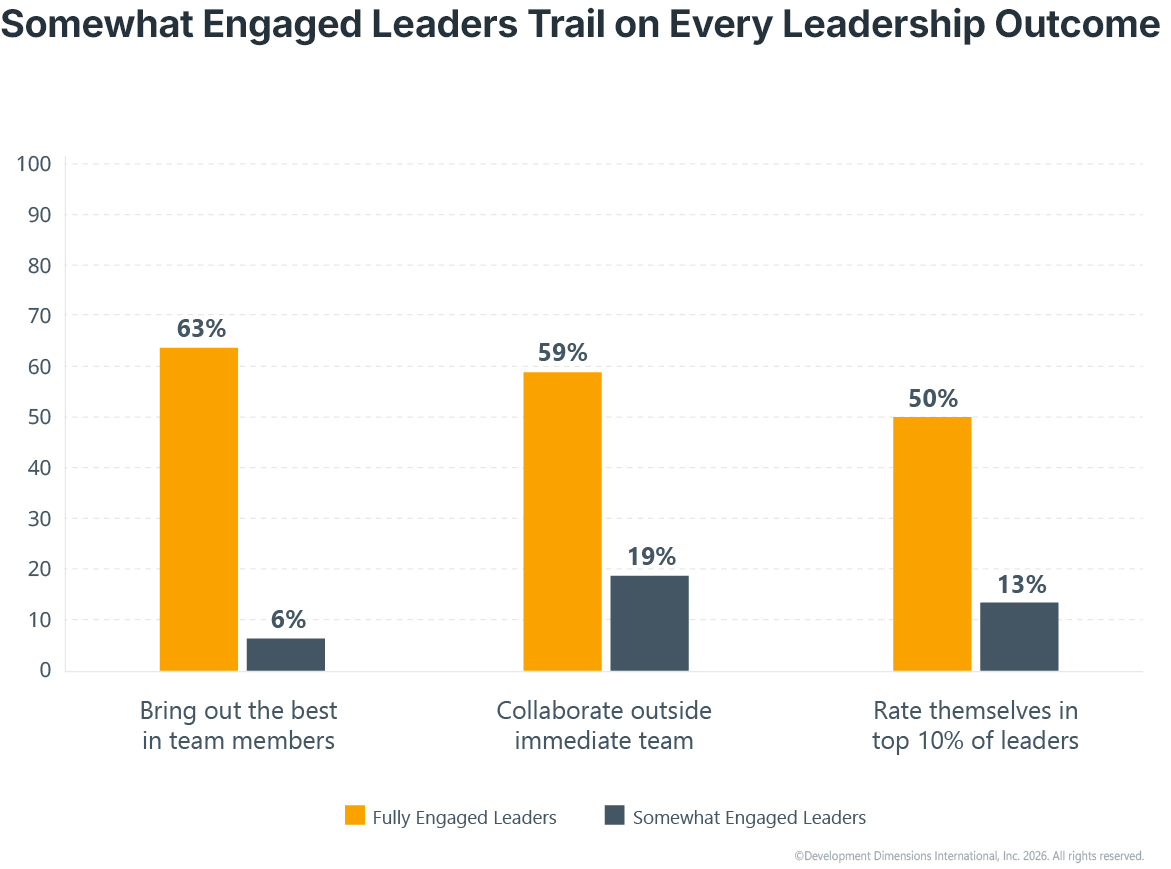
Many of these leaders are getting by, but few are thriving. Only 9% of leaders are fully engaged, and half sit in a lukewarm “somewhat engaged” middle. What keeps them there isn't whether they wanted the job. It's whether anyone helps them grow into it. Reluctant leaders with an effective manager coach are 1.3X more likely to be fully engaged than eager leaders without that support. Yet only 25% of leaders say their manager coaches well.
Our Prediction for 2027
In 2027, more leaders will be doing jobs they didn’t apply for than jobs they did. An increased span of control, a merged team, or a new AI-driven workflow will change a leader’s role as much as any promotion, yet almost no organization will treat it like one. Development will stay tied to job titles while the actual job changes underneath them, and more leaders will stay stuck at “somewhat engaged.”
The organizations that break this pattern will make coaching a core part of every manager’s job, not a nice-to-have. As AI absorbs more of the information-processing side of management, a larger share of what’s left is human: building trust, developing people, critical thinking, and human judgment. That raises the stakes on skills most managers haven’t mastered. And they matter well beyond engagement. Leaders who say their manager coaches effectively are 9X more likely to trust that manager, and trust is what turns decisions into action.
Trend #3: Human Leadership Skills Will Determine AI’s Value
What’s Happening
Leaders have embraced AI, but adoption isn’t the same as capability. Only 10% of HR professionals say their leaders use emerging technologies successfully. Two in five leaders (40%) use AI to analyze data and make decisions, yet only 18% say their leaders check AI output for quality. And the human skills that make that judgment possible sit near the bottom of leaders' development priorities: critical thinking ranks ninth of 15, and empathy ranks last.
Our Prediction for 2027
An AI quality reckoning is coming in 2027. With more decisions built on AI outputs and so little of it checked, we expect organizations to face visible, potentially costly failures traced back to leadership decisions based on AI analysis nobody questioned.
At the same time, CFOs will start asking why individual productivity gains aren't showing up in business results. The answer will turn out to be leadership capability, especially the human skills leaders ranked last. When leaders consistently listen and respond with empathy, their teams see a 42% higher rate of productivity gains from AI and a 61% higher rate of improvement in output quality. AI can’t provide judgment, critical thinking, empathy, or trust, and those are the skills that will determine whether the AI investment pays off.
When leaders consistently listen and respond with empathy, their teams see a 42% higher rate of productivity gains from AI and a 61% higher rate of improvement in output quality.
That puts leadership development in a new position. Budgets are already tipping toward AI, often at the expense of training. In 2027, the organizations that get the most from their AI investment will be the ones that stop treating leadership development as a separate line item competing for funding and start treating it as part of the AI investment itself: the part that makes it pay off.
How HR Can Prepare for Leadership in 2027
Although these trends highlight different challenges, they point to a common problem: Organizations are asking leaders to navigate greater complexity without consistently giving them the capabilities or support to succeed.
HR faces a difficult paradox of its own. Leaders often struggle to make time for development because they're overwhelmed by work. Yet without development, they may lack the skills to manage that work more effectively.
With budgets under pressure and competing priorities growing, organizations need to be more deliberate about where they invest, how they build capability, and how they support leaders in applying what they learn.
Three priorities can help HR get ahead of the challenges leaders will face in 2027:
1. Reset Your Leadership Baseline
Start by understanding what your leaders are capable of today, rather than relying on assessments or assumptions made before their roles changed. Do it before 2027 plans and budgets lock, even if you've assessed recently. Focus on:
- Changing leadership demands: Consider how restructuring, new technologies, and evolving business priorities have changed what leaders are expected to do.
- Current leadership capabilities: Assess how well leaders are equipped to meet those expectations.
- Critical development gaps: Identify where leaders need additional support in change readiness, strategic judgment, coaching, and interpersonal effectiveness.
Objective leadership assessments can help organizations distinguish between leaders who lack potential and those who simply haven't had the opportunity to develop the capabilities now required.
That distinction matters most when organizations make difficult decisions about succession, restructuring, and where to invest limited development resources. The gaps you find also double as your AI business case: They’re the skills that will determine whether your AI investment pays off.
2. Build Coaching Capability from Within
As leadership responsibilities expand and change, organizations need to ensure development keeps pace. That means equipping managers to coach their people through unfamiliar situations, shifting expectations, and difficult decisions.
Building coaching capability across the organization starts with helping managers:
- Treat a scope change like a promotion: When a reorganization, a larger team, or a new AI-driven workflow changes the job, start a development reset, just as you would after a promotion.
- Coach through real challenges: Ask questions, provide feedback, and help leaders work through problems rather than simply providing answers. Measure coaching by whether it helps people grow, not by how often it happens.
- Make development part of everyday work: Create regular opportunities for reflection, practice, and growth instead of limiting coaching to formal development conversations.
When managers can coach effectively, development becomes more accessible and relevant to the challenges leaders face. It can also strengthen engagement and trust, particularly when organizations navigate uncertainty and change. AI coaching can extend that work by giving leaders a private place to practice between conversations. In fact, leaders with both manager and AI coaching are 8X more likely to rate their development as high quality than leaders with no coaching. But AI can't replace a manager who knows the work and holds leaders accountable.
Leaders with both manager and AI coaching are 8X more likely to rate their development as high quality than leaders with no coaching. But AI can't replace a manager who knows the work and holds leaders accountable.
3. Combine Focused Development with Ongoing Support
Leaders need opportunities to build critical capabilities quickly, but lasting behavior change requires more than a single learning experience. Organizations should combine focused skill development with support that helps leaders apply and reinforce what they’ve learned.
An effective approach brings together two elements:
- Realistic practice. Give leaders opportunities to strengthen judgment, decision-making, and interpersonal skills through simulations, immersive experiences, and challenging scenarios.
- Ongoing reinforcement. Extend learning through personalized development and AI-enabled support that helps leaders apply new skills as challenges arise.
These three priorities work best together. DDI’s research shows that leaders who receive a combination of assessments, manager coaching, and AI-enabled learning are 9.3X more likely to be rated very capable of managing rapid change.
The Future of Leadership Depends on What Can't Be Outsourced
As organizations enter 2027, technology, restructuring, and constant change will continue to reshape how leaders work. But navigating these challenges will require more than technical capabilities. Leaders will need the judgment to make difficult decisions, the empathy to understand their teams, and the coaching skills to help others navigate uncertainty.
For HR, the opportunity isn't simply to do more with less. It's to make smarter investments in leadership capabilities that address multiple challenges at once. Assessing leaders' current strengths, building coaching capability, and combining focused development with ongoing support can help organizations prepare leaders for changing expectations.
The organizations best positioned for 2027 won't necessarily be those that adopt technology fastest or restructure most aggressively. They'll be those that recognize what technology can't replace and invest in the people responsible for leading through change.
Have a Question?
FAQs About Leadership Trends 2027
-
What are the top leadership trends for 2027?

The top leadership trends for 2027 are rising change fatigue, the growth of accidental leaders, and the growing role of human leadership skills in determining AI’s value. DDI’s Global Leadership Forecast 2027 finds that only 17% of leaders feel very prepared for change, half of leaders sit in a lukewarm middle of engagement, and only 18% say their leaders check AI output for quality. Together, these trends show leaders being asked to navigate more complexity, often without the support or skills they need.
-
How will AI change leadership in 2027?
AI will take on more of the information-processing side of management, such as analyzing data and informing decisions. That makes human judgment more important, not less. Two in five leaders already use AI to make decisions, yet critical thinking and empathy rank near the bottom of leaders’ development priorities. DDI predicts an AI quality reckoning in 2027, which will put greater scrutiny on the capabilities that determine whether AI investments pay off: judgment, critical thinking, empathy, and trust.
-
Why are leadership pipelines at risk in 2027?
Eighty-eight percent of HR professionals lack confidence in their leadership pipeline. Constant restructuring is forcing faster decisions about which leaders are ready for what’s next, and many organizations risk writing off capable leaders as “not ready” instead of developing them. That shrinks an already thin bench. When strategy shifts again, those organizations will have fewer leaders ready to step up and less time to develop them.
-
How can HR prepare leaders for 2027?
DDI recommends three priorities. First, reset your leadership baseline with objective assessment before 2027 plans and budgets lock. Second, build coaching capability from within, so managers can support leaders through scope changes, not just promotions. Third, combine focused development with ongoing support. These priorities work best together: Leaders who receive a combination of assessments, manager coaching, and AI-enabled learning are 9.3X more likely to be rated very capable of managing rapid change.