


Summary
Effective blended learning strategies combine multiple development methods to give leaders the right learning experience at the right time. Rather than simply offering a mix of in-person, virtual, and self-paced learning, the strongest strategies intentionally connect these experiences so they build on and reinforce one another. By combining assessment, facilitated learning, coaching, peer learning, practice, and digital tools, organizations can create more flexible, personalized development that helps leaders apply new skills on the job.
It seems like the top barrier to a successful leadership development program has shifted over time. In the past, customers I worked with described obstacles like lack of training rooms, insufficient training budgets, or the absence of executive support. Now, the main barriers have coalesced around one primary challenge: How do we capture leaders’ time and attention amid the increasingly demanding roles they occupy?
That’s where blended learning strategies can help. By intentionally combining different development experiences, organizations can give leaders greater flexibility while still providing the practice, interaction, and reinforcement they need to build new leadership skills.
What Is Blended Learning for Leadership Development?
Blended learning in leadership development involves intentionally combining different learning methods and experiences to help leaders build and apply new skills. That might include instructor-led learning, virtual classroom experiences, self-paced courses, microlearning, assessments, coaching, peer learning, immersive scenarios, and opportunities to practice on the job.
Some experiences happen independently, while others bring leaders together to learn, discuss challenges, practice skills, and learn from one another. At its best, blended learning leverages the strengths and efficiencies of each modality while acknowledging their limitations.
The goal isn’t simply to offer leaders more ways to learn. An effective blended learning strategy connects those experiences so each one serves a purpose and reinforces what comes before and after it.
What Are the Tools for Blended Learning?
There’s no single formula for the right blend. Each learning method offers different strengths, and each has limitations when used on its own. The key is choosing methods based on what leaders need to learn, practice, and apply. Five common tools can help organizations build the right blend:

1. In-Person Classroom Training
The in-person classroom provides formal opportunities for leaders to receive live, face-to-face instruction. It brings learners together in a space specifically designed for learning. They benefit not only from the instruction but also from the networking and community-building that come with meeting in person. It also creates valuable opportunities for discussion, feedback, and live skill practice.
But in-person training can be one of the least flexible development methods. This form of learning often requires the biggest time commitment from both learners and facilitators. In many cases, travel time and cost factor into the overall investment. Organizations also need to consider how they will reach leaders who aren’t located near a training site.

2. Virtual Classroom
A virtual classroom is live, instructor-led leadership development delivered through a remote meeting platform like Zoom. It has some of the same benefits as an in-person classroom. Breakout discussions and interactivity are still key features—but learners are in the privacy and comfort of their own homes or workspaces.
Virtual classroom learning can offer many benefits of an in-person experience, with greater flexibility and reach. But simply moving classroom content online isn’t enough. Well-executed virtual classroom training can be just as engaging as in-person training with the right design and facilitation.
Another challenge with virtual classroom training is keeping leaders engaged for longer periods online. This is where blended learning can help the virtual classroom shine. If you can teach foundational concepts in a short, self-paced pre-work course, you can reserve live learning time primarily for group interaction, discussion, and practice.
3. Flipped Classroom
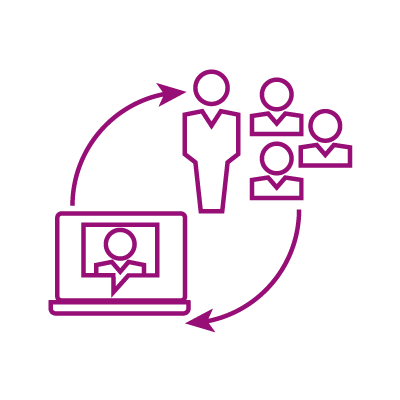
This blended learning format, which may involve in-person or virtual instructor-led training, relies on learners engaging with content on their own ahead of a group session. Then, during the live event, instead of spending time on the more conceptual parts of the learning, learners can immediately begin interacting with content in a more hands-on way. Deep discussions, activities, and skill practice are just a few examples.
The flipped classroom maximizes time spent on the kinds of learning that can only happen when learners are together. But it does come with a limitation: flipped learning requires a high level of accountability. For best results, learners must engage with the assigned content before class. If learners skip the pre-work, the facilitator will need to cut into interactive learning to get them caught up.
That makes reinforcement and accountability an important part of the flipped classroom strategy—and of blended learning in general—rather than leaving each learning experience to stand on its own.

4. Online Courses
Self-paced online courses are among the most flexible tools in the learning professional’s toolkit. Anyone can use them, anywhere, at any time. Online learning can also support greater personalization by giving leaders access to development that aligns with their individual needs and moments of need.
But flexibility alone doesn’t guarantee impact. Self-paced courses typically offer fewer opportunities for peer discussion, feedback, and live practice. That’s why they're more powerful when connected to other development experiences than when offered as a standalone content library.
The difference matters. Only 37% of organizations report strong ROI from standalone learning libraries, compared with 54% for objective diagnostic assessments, 53% for executive coaching, and 51% for 360-degree feedback.
The takeaway isn’t to abandon self-paced learning. It’s to connect it with the insight, interaction, and practice that help leaders apply what they learn.

5. Microlearning
Microlearning is a subset of online learning in which the content is much shorter. Whereas online courses may take longer to complete, learners can typically complete microlearning in just a few minutes.
While longer forms of learning, like coaching, explore a broad concept, microlearning narrows in on a more specific topic, such as a model for giving feedback for improvement. Due to its short duration, microlearning is often used for just-in-time learning. Microlearning is also frequently used to reinforce or deepen knowledge gained in formal learning.
Like other self-paced methods, microlearning is most effective when it has a clear role in the broader development experience. For example, a short activity can reinforce a skill after facilitated learning or help a leader prepare for an upcoming conversation.
What Are Blended Learning Strategies?
The right blended learning strategy will look different for every organization, but it works best when different forms of learning are intentionally connected through a learning journey. Each experience can then support, build on, and reinforce the others rather than standing alone.
In-person classroom and virtual classroom experiences often serve as effective ways to kick off a learning journey. Why? Face-to-face collaboration can build a sense of purpose for the journey and cohesiveness among learners.
Then, after learners are committed to and engaged in the blended learning program, organizations might introduce flipped learning. Online courses and microcourses can also serve as effective intersession activities. When participants know they will be called upon to discuss or apply what they learned in the next live session, self-paced learning connects to a larger purpose rather than becoming another item to complete.
In one client example, DDI helped create a blended learning journey for frontline leaders. Leaders began with a personalized assessment experience, which helped identify development needs and guide both digital learning and live group sessions. The result was a more connected experience that combined personalized development with opportunities to build skills together and apply them back on the job.
The sequence will look different for every organization. What matters is that each experience has a clear role in helping leaders build, practice, reinforce, or apply a skill.
How to Build Effective Blended Learning Strategies for Leadership Development
A strong blended learning strategy starts with the outcomes leaders and the business need, then determines which development methods can best support them. Use these strategies to create the right blend:
1. Start with Your Leaders’ Needs
Different leader levels have different expectations and learning needs. Rather than assuming one blend will work equally well for everyone, consider leaders’ roles, experience levels, development needs, and the situations where they will need to apply new skills.
Assessment can help make those decisions more objective. Diagnostic assessments can identify strengths and gaps before development begins, giving organizations a clearer basis for deciding what leaders need rather than relying on a one-size-fits-all curriculum.
2. Connect Learning to Business Priorities
Blended learning is most valuable when it helps leaders solve real challenges, not when it simply gives them more content to consume. Start by identifying the business priorities your leaders need to support and the behaviors they will need to demonstrate to deliver on them. This can be a company initiative, a change management process, or a new business strategy.
Connecting development to these priorities makes learning more relevant and gives leaders opportunities to apply new skills directly to their work.
How do leadership development professionals do this? They frame their blended learning strategy around something visible to all leaders.
3. Personalize the Blend
One advantage of blended learning is that it makes it easier to create a more personalized learning experience by leveraging high-quality leadership assessments. Assessment insights help leaders focus on the areas where development will have the greatest impact, rather than sending everyone through the same experience.
That more targeted approach is also linked to stronger outcomes. Companies that pair assessments with coaching are 1.8X more likely to be among the top 10% of financial performers than those that don’t.
Many organizations make the mistake of making large libraries of self-paced content available without providing enough guidance on what leaders should use and when. But we can’t expect learners in a busy, chaotic world to sort through massive libraries of online content to find what they need. Instead, use assessment insights and curated learning paths to guide leaders toward development that fits their needs while still giving them flexibility and choice.
The Benefits of Blended Learning Strategies
Blended learning is one of the most powerful tools in the modern learning and development professional’s toolbox. The key is to avoid thinking of it as a mere tactic to shorten training sessions, or as an event-based approach at all.
Rather, effective blended learning creates a development experience in which leaders can access the right kind of learning at the right time. This might look like taking a microcourse one day to prepare for a difficult conversation. On a different day, it might look like spending more focused time in instructor-led training for deeper learning, skill practice, and peer networking.
The strongest blended learning strategies make development part of how leaders work. They combine flexibility with structure, personalization with shared experiences, and learning with opportunities to practice and apply new skills.
And ultimately, success isn’t about how many modalities an organization offers. It’s about whether those experiences work together to change what leaders do. Seventy-eight percent of HR leaders say visible behavior change is the most valued metric of development success.
When blended learning is intentionally designed around that goal, every element has a purpose: helping leaders build skills they can apply when it matters most.
Have a Question?
Frequently Asked Questions About Blended Learning Strategies
-
What are blended learning strategies?

Blended learning strategies intentionally combine different development methods, such as instructor-led learning, virtual classroom experiences, self-paced courses, microlearning, assessments, coaching, peer learning, and practice. The goal is to use each method where it adds the most value and connect the experiences so they reinforce one another.
-
Why are blended learning strategies effective for leaders?
Blended learning helps organizations capture leaders’ limited time and attention by offering flexibility without sacrificing impact. When designed as a learning journey, it reinforces skills over time and supports sustained behavior change.
-
What is an example of a blended learning strategy?
A blended learning strategy might begin with an assessment to identify development needs, followed by self-paced learning to introduce key concepts. Leaders could then attend a facilitated session to discuss and practice skills, apply those skills on the job, and receive coaching and reinforcement afterward.
-
Why is blended learning effective for leadership development?
Blended learning gives organizations the flexibility to use different development methods for different purposes. Leaders can gain knowledge independently, practice skills with others, receive feedback and coaching, and access reinforcement when they need it. Connecting these experiences can help move leaders from learning a skill to applying it on the job.
-
What should a blended learning strategy include?
An effective blended learning strategy can include assessments, instructor-led and virtual learning, self-paced courses, microlearning, coaching, peer learning, immersive practice, and on-the-job application. The right mix depends on leaders’ needs, business priorities, and the behaviors the organization wants to develop.